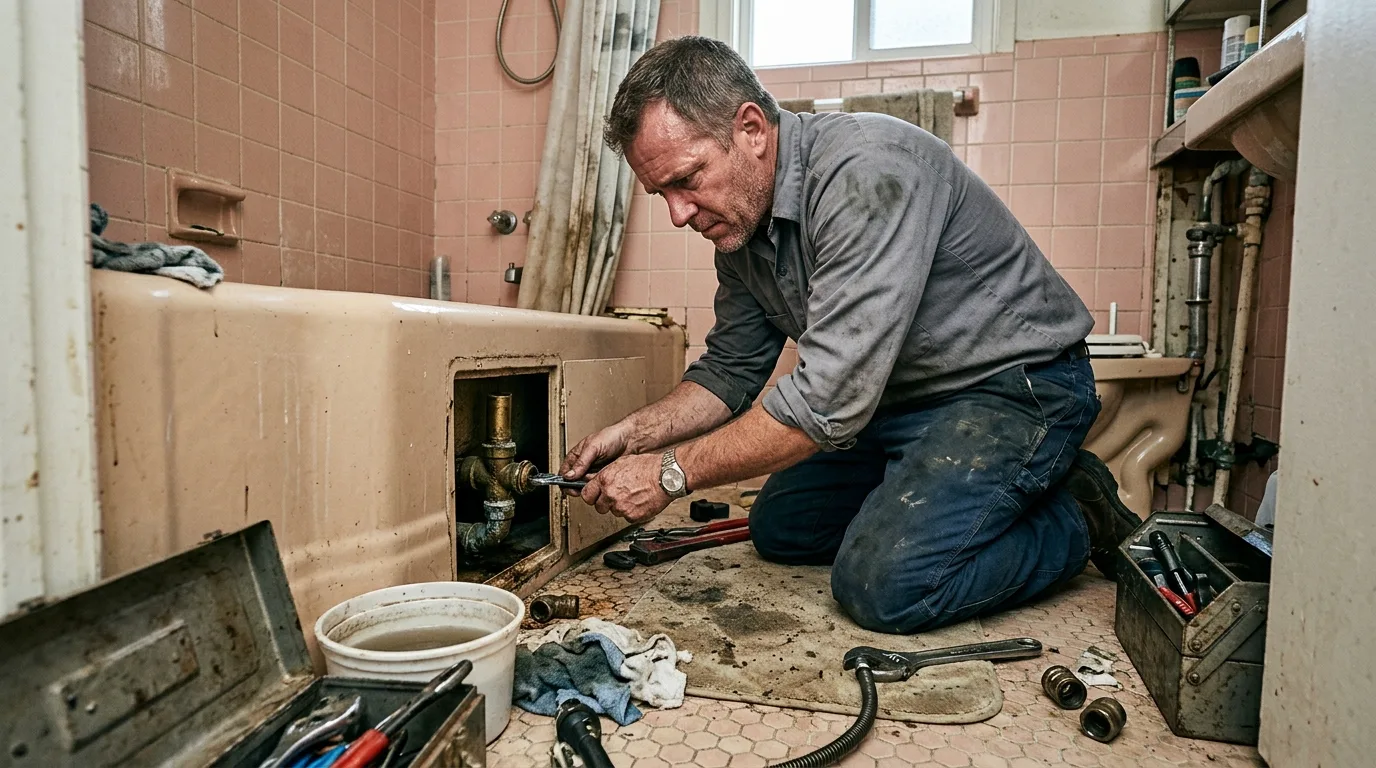
More than one fixture backing up
Two or more fixtures at once means the shared line, not the trap. If the lowest drain in the house is involved, treat it as urgent.
Eichler tract · Orange, CA
An Eichler tract in the City of Orange. Supply pipe can be abandoned and rerouted overhead. Drainage runs downhill inside the slab and stays exactly where it was poured, which makes it the half worth watching.
Ask for a camera before anyone quotes a drain repair here. Guessing is expensive.
Answered 24/7
Every hour, every day, including holidays.
Same-day & emergency
Urgent calls get moved to the front of the queue.
Upfront pricing
A number you approve before work begins.
No hidden fees
The price you agreed to is the price you pay.
Workmanship terms upfront
Ask the plumber what their own workmanship terms are before work starts.
The asymmetry
Every Eichler conversation about supply pipe ends with the same reassurance: abandon it and run new pipe overhead. Drainage gets no such escape. It works on gravity, at a fixed fall, in the position it was set, so when it fails, the fix is in the concrete or in the ground.
Two or more fixtures at once means the shared line, not the trap. If the lowest drain in the house is involved, treat it as urgent.
A cable clears the blockage; six weeks later it is back in the same place. That is a defect in the pipe holding waste, not a habit, and it is what a camera is for.
An enclosed planting court is charming and drains through one modest point. When that point silts up or the line beyond it fails, the water has nowhere to go but the threshold.
Often drainage rather than plumbing, a blocked courtyard or roof drainage path pushing water where the slab meets the frame.
Decades of root growth alongside a clay or cast-iron lateral. Roots find joints, joints leak, and the leak feeds the roots.
A dry trap, a failed connection under the slab, or a vent problem. Worth locating properly rather than masking.
Start here
On the drain side of one of these houses, a camera survey is the cheapest thing that happens all week. It names the defect, whether that is root intrusion at a joint, a crack, an offset where two sections have shifted, or a belly where a section has lost its fall and holds water permanently, and it puts a distance and a depth on it.
That matters because the repairs are wildly different in cost and disruption. A root intrusion at a reachable joint is a modest job. A belly under the middle of a finished slab is a different conversation entirely, and one you want to have with a recording in front of you rather than a hunch.
Insist on seeing the footage. Not a description of the footage, the footage, with the distance counter visible. Anyone who cables a line, quotes a slab excavation and never puts a camera down it is asking you to fund a guess.
It also protects you the other way. Plenty of recurring blockages turn out to be a maintenance pattern rather than a broken pipe, and the camera is what tells you to stop worrying.
A recording, a distance to the defect, a depth, a described condition, and a marked location on the ground. That is the document you get second opinions with.
Outside the walls
The atrium or courtyard plan is the pleasure of these houses and a drainage question at the same time. An enclosed court collects rain and irrigation and releases it through one or two small points that are, by design, surrounded by planting. Silt, leaves and root growth all work against those points, and there is no second route once they close.
A flat roof works the same way: a small number of drainage points doing all the work, with a ponding problem the moment one is obstructed. It is not strictly plumbing, but it is often the same visit and the same person, and it is worth asking about while someone is there.
Then there is the lateral out to the main, generally clay or cast iron of the same vintage, running under whatever the garden has become in sixty years. Roots at the joints, sections that have shifted, grade that has settled. Trenchless lining and pipe bursting exist precisely so a mature garden does not have to be trenched end to end, worth asking whether your lateral is a candidate.
The supply-side questions live on the other two tract pages: Fairhaven for the warm-floor diagnosis, Fairhills for repiping and routing.
Clear the atrium and courtyard drainage points before the first real rain each year, and get the lateral cameraed once rather than never. Both are cheap, and both catch the failures that are expensive on the day they surface.
One number, any hour
We will connect you with a local pro who puts a camera down the line before quoting anything that involves concrete.
Most asked for here
The first step on any recurring blockage here.
Sewer Camera InspectionCabled or jetted, once the line has been seen.
Drain CleaningRoot-invaded joints, offsets and lost grade.
Sewer Line RepairReplacing the lateral without trenching the garden.
Trenchless Sewer RepairScale and root cutting, when the pipe can take it.
Hydro JettingAnswered 24/7, holidays included.
Emergency PlumbingSay how many fixtures are affected and whether it has happened before. That is most of the diagnosis.
Straight answers
More than one fixture means the shared line rather than a single trap, and if the lowest drain in the house is involved it is a main-line problem. Stop using water and call.
Continuing to run water pushes waste toward the lowest opening, which is usually a shower pan or a floor drain.
Because clearing a blockage does not fix what caused it. A recurring blockage in the same place is a defect in the pipe; roots at a joint, a crack, an offset, or a belly holding water.
A camera survey names which, and that decides whether you are looking at a spot repair or something larger.
Before anything involving concrete or excavation, yes. It is the cheapest step and it converts a guess into a distance, a depth and a described defect.
Ask to watch the footage with the distance counter visible, and to be given the recording.
It is drainage, and it is often the same visit. An enclosed court drains through one or two small points surrounded by planting, and silt, leaves and roots close them.
Once that point is obstructed there is no alternative route, which is why water reaches the threshold.
Often. Cured-in-place lining and pipe bursting are designed for exactly this, a mature garden or a driveway that would be ruinous to trench.
Whether your lateral is a candidate depends on its condition and geometry, which is another thing the camera survey establishes.
In sixty-year-old clay and cast iron under mature landscaping, frequently. Roots do not break sound pipe so much as exploit joints that have already loosened, then thicken inside the line.
Cutting them buys time. Lining or replacing the section is what ends it.
It depends on where the defect is and what it is. Some are reachable from a cleanout or an exterior point, some are linable, and some genuinely require opening the slab at one located spot.
This is precisely why the location and depth from a camera survey matter before anybody prices anything.
Common causes are a trap that has dried out in a little-used fixture, a vent problem, or a failed connection under the slab.
Worth locating rather than masking, the first is trivial to fix and the last is not, and only one of them gets worse.
An independent local plumbing professional. Orange CA Plumbing Line is a referral service, not a plumbing contractor.
They diagnose, quote, perform the work and set out their own workmanship terms with you. Nothing is billed through us.
Tell us how many fixtures, whether it has happened before, and whether it rained. That names the job.
Nearby, and related
One number, any hour
We will connect you with a local plumbing pro who cameras the line first and tells you what the recording shows.