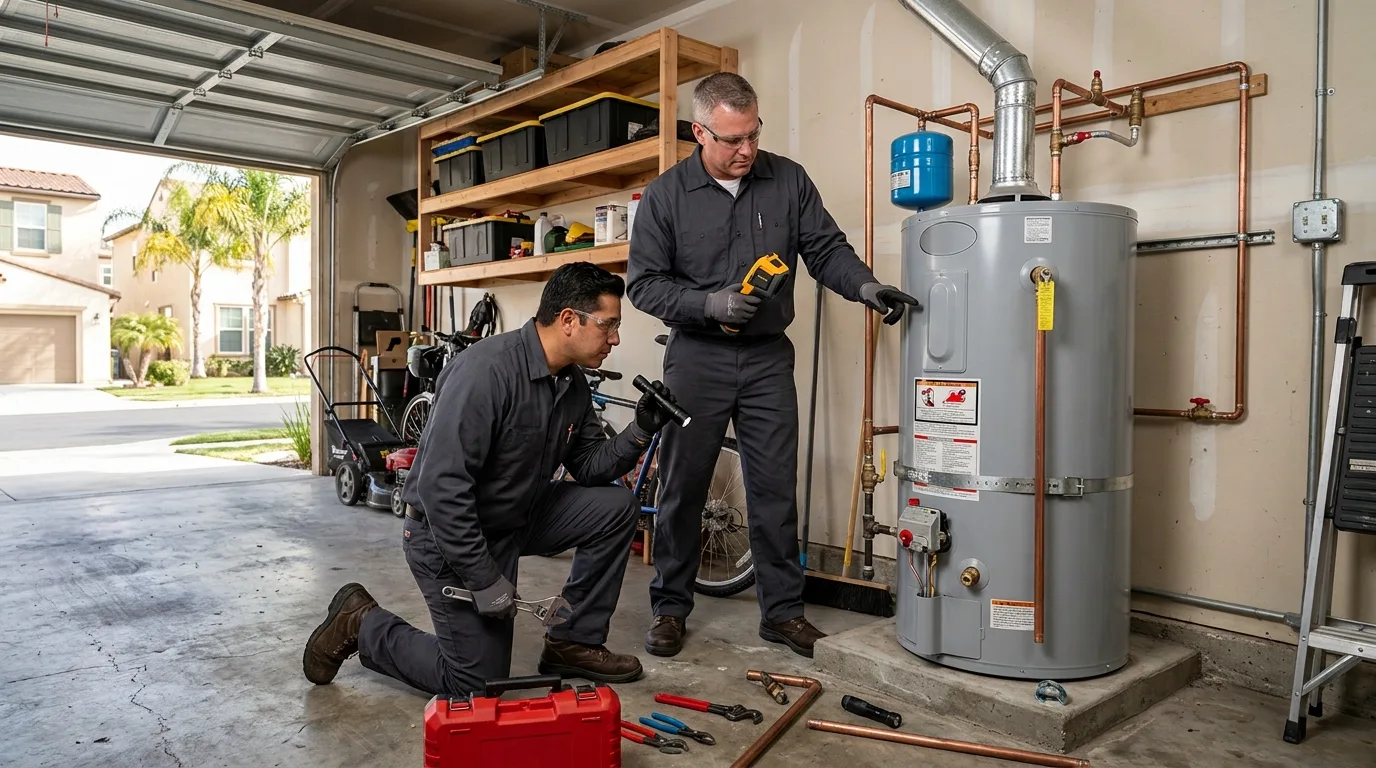
Water heater repair in Orange, CA. Diagnosed before it is condemned
No hot water, a tank that rumbles like a kettle, rusty water on the first draw, a pilot that will not hold. Component failures get repaired; failed tanks get replaced. You get both numbers and the reasoning.
Water pooling at the base? Close the cold inlet valve on top of the tank, then call.
What to expect
Answered 24/7
Every hour, every day, including holidays.
Same-day & emergency
Urgent calls get moved to the front of the queue.
Upfront pricing
A number you approve before work begins.
No hidden fees
The price you agreed to is the price you pay.
Workmanship terms upfront
Ask the plumber what their own workmanship terms are before work starts.
Symptoms
What the tank is telling you
Most water heaters give weeks of warning. Learning to read them is the difference between a scheduled repair and a Saturday morning with cold showers and a wet garage floor.
No hot water at all. On gas, usually a pilot that will not stay lit, a failed thermocouple or a gas control valve. On electric, a failed element or thermostat, or a tripped high-limit switch. All are component repairs, not tank failures.
Rumbling, popping or a kettle-like boil. Sediment on the tank floor with water trapped underneath it. That is hard water arriving in the form of noise, and it costs you efficiency and tank life.
Not enough hot water any more. A tank that used to fill the bath and now does not. Often sediment stealing volume, sometimes a failed lower element on electric, sometimes a dip tube.
Rusty or metallic-smelling hot water. Frequently a spent anode rod, a sacrificial part that is supposed to corrode so the tank does not. Replacing it is cheap; ignoring it shortens the life of the whole unit.
Water at the base. This is the one that decides things. A weeping fitting, a valve or a connection is repairable. Water seeping from the tank body itself means the tank has failed and no repair will bring it back.
The relief valve discharging. The temperature and pressure relief valve is a safety device. If it is releasing, something is wrong, excess temperature, excess pressure, or a failed valve, and it should never be capped or plugged.
Gas smell, or soot around the burner or vent. Stop. Leave the building and call from outside.
Water pooling at the base? Close the cold inlet valve on top of the tank, then call.
The honest question
Repair, or replace?
This is the conversation where homeowners most often feel pushed, so here is the framework a straight plumber uses.
Repair is usually right when
The tank is sound and a component has failed. Thermocouples, gas valves, elements, thermostats, dip tubes, anode rods and relief valves are all replaceable parts, and on a unit in the first half of its life replacing one is clearly the better spend. A noisy tank that flushes well and holds temperature afterwards is also a repair.
Replacement is usually right when
The tank itself is leaking, no exceptions, that is a failed vessel. Or the unit is near the end of its expected service life and something significant has failed, in which case you are buying a repair with a short runway. Or it is badly undersized for how the household actually lives now, which no repair addresses.
The grey zone
A mid-life unit with a moderately expensive failure. Here the deciding factors are honest ones: what the repair costs against a new unit, whether the tank has been flushed regularly, whether the anode has ever been changed, and whether the current install meets today’s requirements, because a replacement often has to add seismic strapping, an expansion tank or a corrected vent, and those belong in the comparison.
What you should get is both numbers and the reasoning. What you should not accept is being told a tank is finished without anyone explaining why.
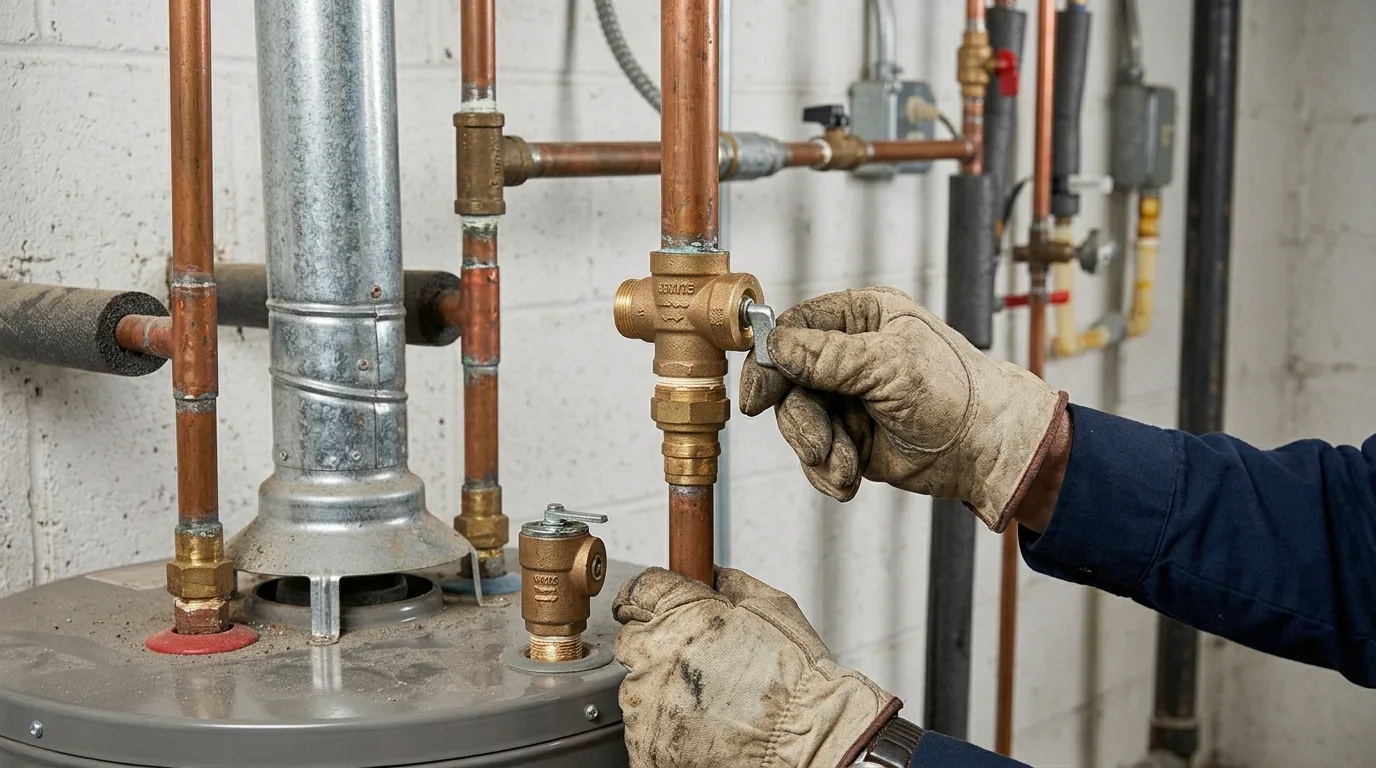
Hard water is why heaters die young here
Imported water in this part of Orange County is hard. Dissolved minerals drop out of solution as water is heated and settle on the tank floor, where they insulate the burner from the water, make the unit work harder, and eventually cook the glass lining. It is the single biggest reason tanks here fail earlier than the brochure suggests, and the reason an annual flush is genuinely worth doing rather than a manufacturer’s formality.
Cold showers, or a wet garage
A weeping fitting today is a failed tank next month.
Get it diagnosed while it is still a repair. We will connect you with a pro who will give you both numbers.
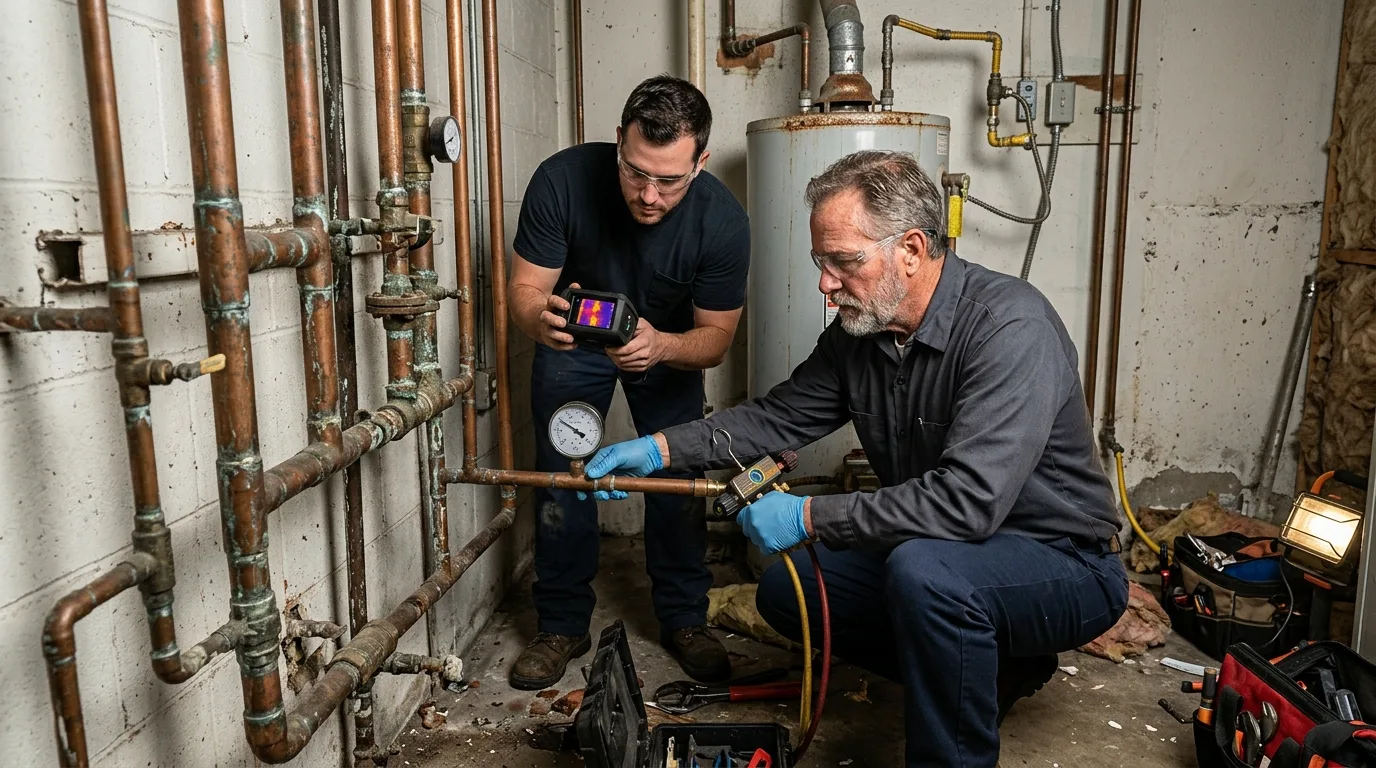
On the day
What a repair visit covers
Confirm the failure. Gas supply and pilot, burner operation, thermocouple, gas control valve, thermostat and element continuity on electric, and the actual delivered temperature. Guessing at a part is how you end up replacing two.
Check the safety items. The temperature and pressure relief valve and its discharge line, the vent and draft on a gas unit, combustion air, and the seismic strapping California requires. These get looked at whatever brought the plumber out.
Read the water side. Incoming pressure, and whether there is a thermal expansion tank where one is needed. High pressure and no expansion control shortens the life of a heater and everything downstream of it.
Flush, if flushing will help. Draining sediment restores capacity and quiets the tank. On a unit that has never been flushed in fifteen years, be aware the drain valve itself sometimes fails during the process, a good plumber warns you of that before opening it.
The anode rod. Rarely mentioned, cheap, and directly tied to how long the tank lasts. Worth asking about on any unit past a few years old.
Then a price, before anything is replaced. Including the alternative, if replacement is the better value.
Money
What changes the cost of a repair
- Which component failed
- Gas or electric
- Age of the unit
- Parts availability for the model
- Where the heater sits
- Access and clearance around it
- Sediment and flush condition
- Whether it is still under warranty
- After-hours or scheduled
Location matters more than people expect. A unit standing clear in a garage is a straightforward job. The same repair in a narrow exterior closet, an interior closet in a 1920s bungalow, or a tight utility space in an Eichler where there is no attic to work above takes longer and sometimes needs the unit moved to be worked on at all.
Also worth checking before you spend: many tanks carry a multi-year warranty on the vessel. Find the model and serial label and mention the date when you call.
Have the model and serial number ready. It answers the warranty question in seconds.
Straight answers
Water heater questions people ask on a cold morning
My water heater is leaking. Can it be repaired?
It depends entirely on where the water is coming from. A weeping fitting, a drain valve, a relief valve or a supply connection is repairable.
Water seeping from the tank body itself means the vessel has failed, and no repair fixes that. Close the cold inlet valve on top of the tank and call.
Why does my tank rumble and pop?
Sediment on the tank floor with water trapped underneath it, boiling and escaping. That is hard water, and this area has it.
A flush often quiets it and restores capacity. On a tank that has gone many years without one, the drain valve occasionally fails during the flush, which your plumber should warn you about first.
How long should a water heater last here?
Less than the brochure suggests, because hard water accelerates sediment and scale. Regular flushing and a replaced anode rod make a real difference to how long you get.
Rather than a number, the useful test is: what has failed, how old is the unit, and has it ever been maintained.
The pilot light keeps going out. Is that serious?
It is usually a failed thermocouple or a dirty pilot assembly; both routine repairs. Sometimes it is the gas control valve.
It can also indicate a venting or combustion air problem, which is not routine. That is why the vent and draft get checked as part of the visit.
Water is dripping from a pipe near the top of the tank. What is that?
Most likely the temperature and pressure relief valve discharging. It is a safety device doing its job, and it usually means excess pressure, excess temperature, or a valve that has failed.
Never cap or plug that line. Get the cause identified, often it is high incoming pressure with no thermal expansion tank.
Do I need an expansion tank?
On a closed system, which is what you have when a pressure regulator or check valve prevents water flowing back to the main, heated water has nowhere to expand, and an expansion tank is how that is handled.
The plumber checks incoming pressure and the setup. Adding one where it is needed protects the heater and the rest of the plumbing.
Is seismic strapping actually required?
Yes, California requires water heaters to be braced or strapped against earthquake movement, and plenty of older installations here either have none or have strapping that would not hold.
It is a small job, it is checked on any visit, and it is not optional on a replacement.
Should I switch to tankless while I am at it?
Sometimes it is a genuinely good move, and sometimes a straight tank replacement is the better value. It depends on gas line capacity, venting, where the unit sits and how the household uses hot water.
Hard water also means a tankless unit here needs periodic descaling to keep its warranty and its efficiency. The tankless page lays out both sides.
Can you come out today?
Yes. Calls are answered 24 hours a day and no hot water is treated as urgent, especially with a household or a rental involved.
If the tank is actively leaking, close the cold inlet valve on top of it before we arrive.
Tell us the symptom and the age of the unit. Have the model and serial label handy if you can.
Often part of the same job
Related services and neighbourhoods
One number, any hour
Get the hot water back on today.
We will connect you with a local plumbing pro who will diagnose the unit rather than sell you a new one on sight.