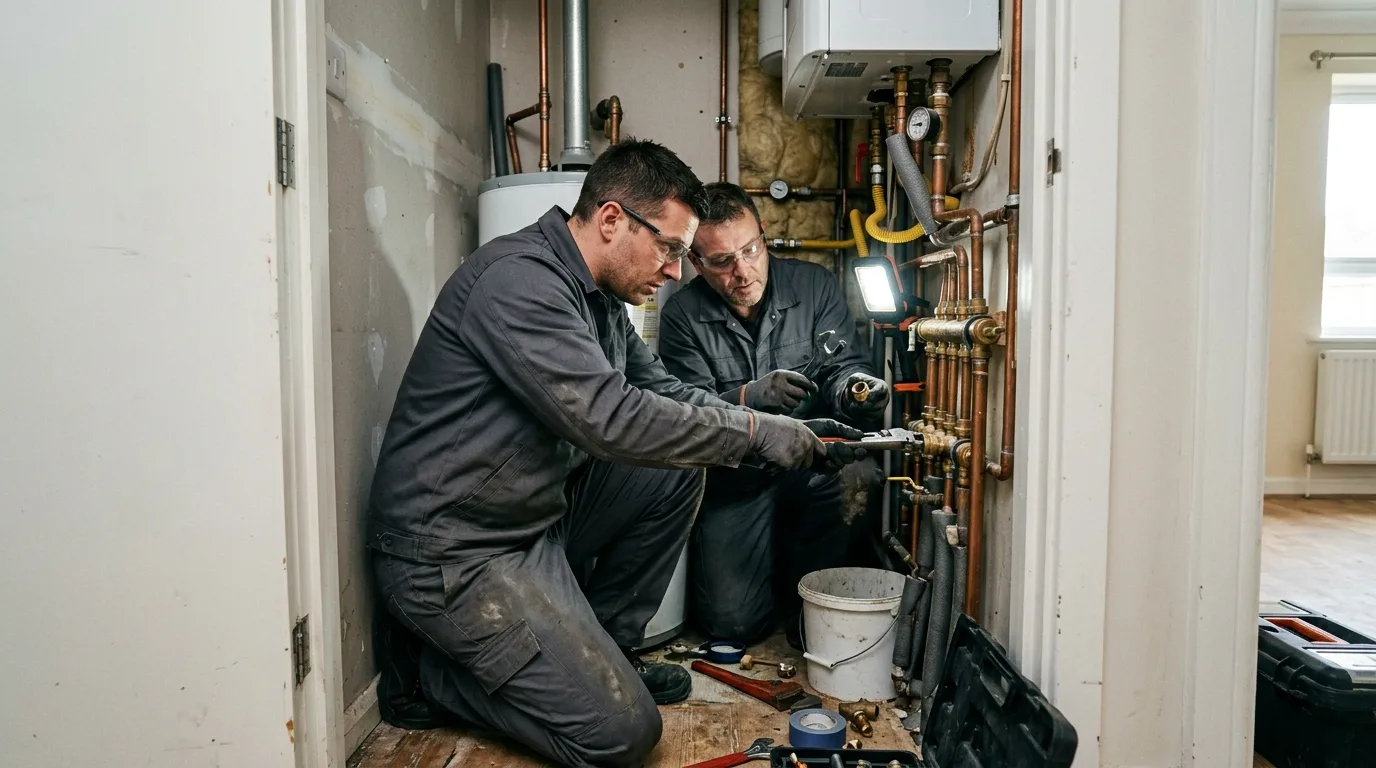
Water heater installation in Orange, CA. Sized right, strapped right, permitted
Garage swaps in the postwar tracts, tight exterior closets in later subdivisions, hall closets in 1920s bungalows, compact utility spaces in the Eichler tracts. Sized on how your household actually uses hot water.
Ask for an itemised quote. Strapping, expansion tank, venting, pan, permit and disposal are where bids really differ.
What to expect
Answered 24/7
Every hour, every day, including holidays.
Same-day & emergency
Urgent calls get moved to the front of the queue.
Upfront pricing
A number you approve before work begins.
No hidden fees
The price you agreed to is the price you pay.
Workmanship terms upfront
Ask the plumber what their own workmanship terms are before work starts.
Choosing
Getting the size and type right the first time
Most bad water heater experiences start with the wrong unit rather than a bad install. Two questions do most of the work.
How does the household actually use hot water?
Not how many people live there, when they all want hot water at once. A house where two showers run back to back and the dishwasher follows needs a different first-hour delivery from one where usage is spread through the day. Filling a deep soaking tub is its own requirement. So is a household that does laundry in hot water. Sizing on bedrooms alone is how people end up with a tank that runs out every morning.
What can the location and the utilities support?
A gas unit needs adequate gas supply, proper venting and combustion air. An electric unit needs the right circuit. A heat-pump unit needs air volume and somewhere for condensate to go. And every one of them has to fit the space with the clearances the code requires, which in a narrow exterior closet or an interior closet in an older bungalow is often the binding constraint.
Gas, electric, heat pump or tankless
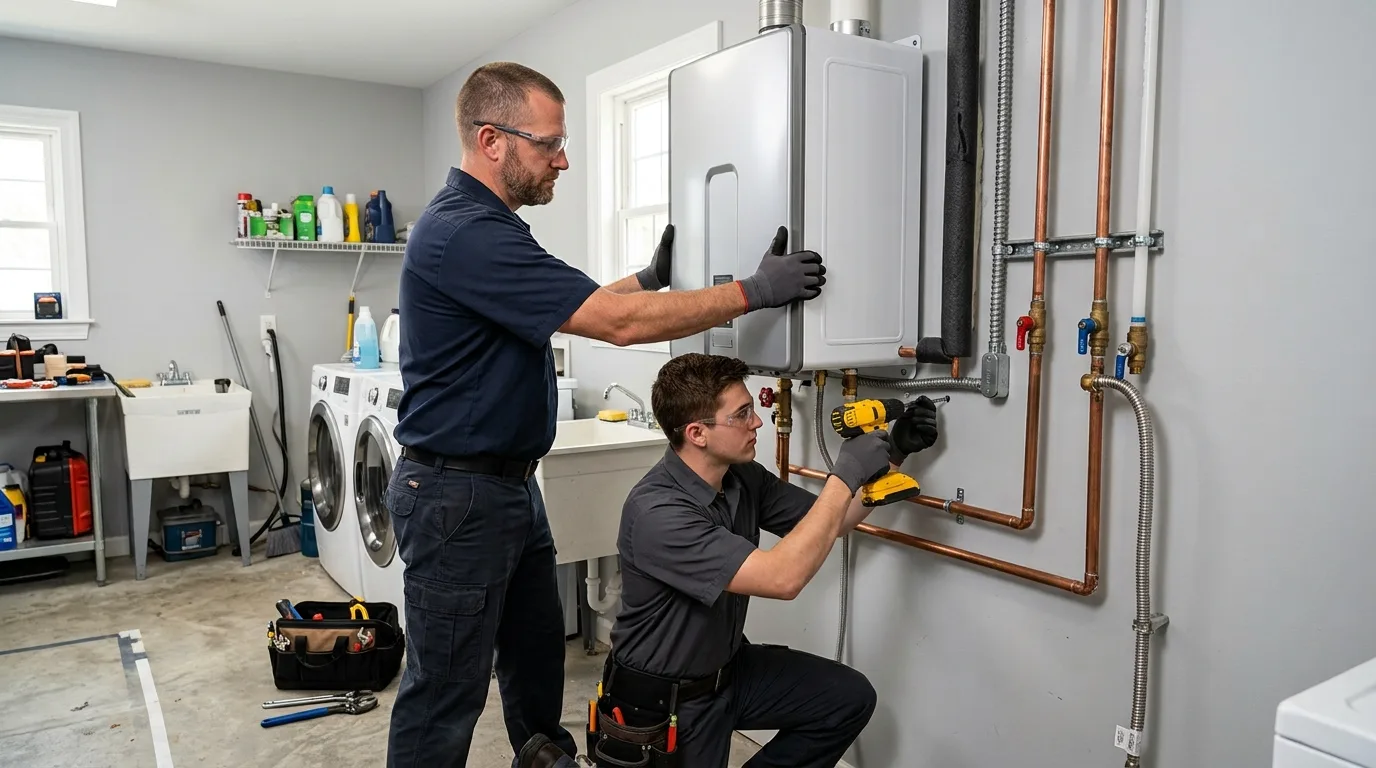
A like-for-like gas or electric tank swap is the simplest and usually the least expensive path. Heat-pump tanks are far more efficient and physically larger, need air around them and produce condensate. Tankless changes the gas, venting and maintenance picture entirely and has its own page. Any of these can be right; the question is which fits your house without a chain of expensive upgrades.
Describe your worst hot water morning. That is more useful than any square-footage rule.
What a proper install includes
The parts of the job that are not the heater
A replacement is rarely just a swap, because requirements have moved on since the old unit went in. These are the items that separate a compliant installation from a cheap one, and they are the most common reason two quotes differ.
Seismic bracing
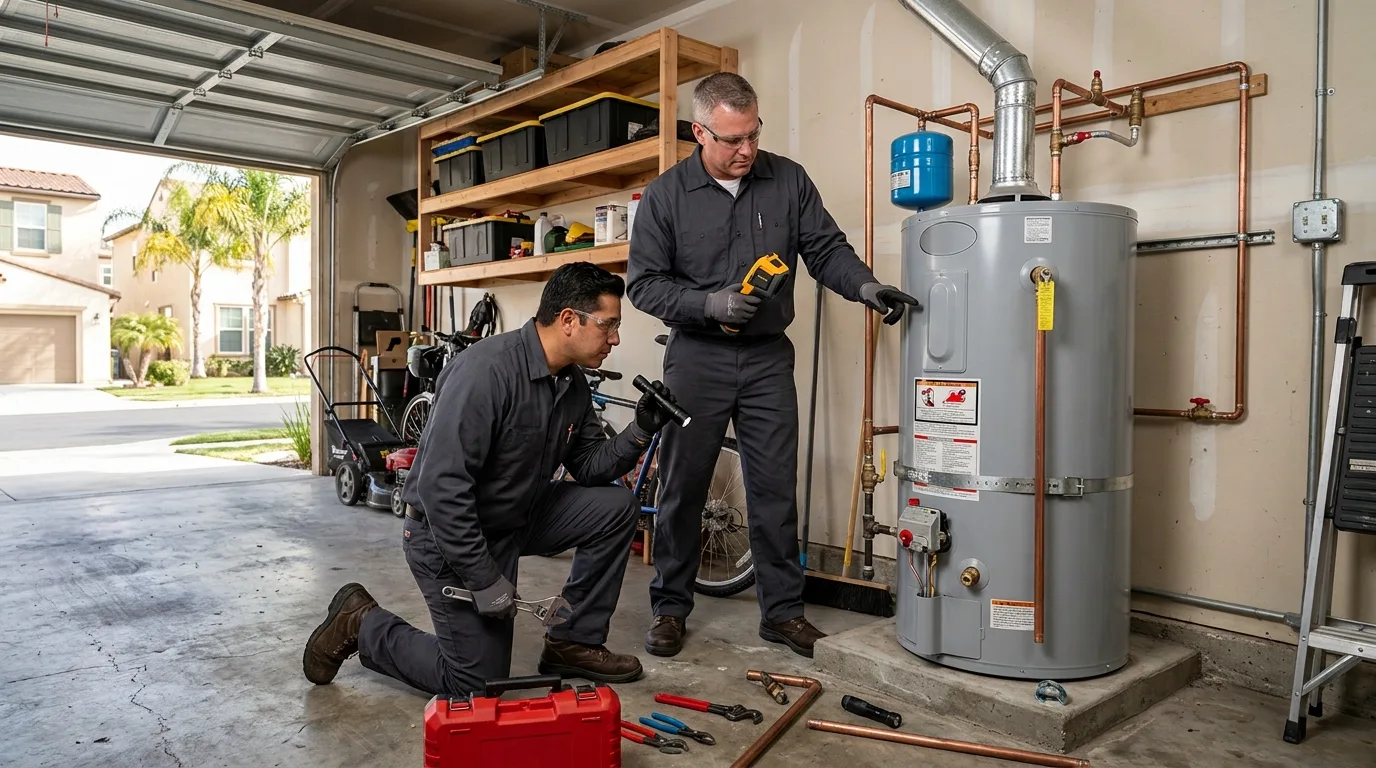
California requires water heaters to be braced against earthquake movement. A great many older installations here have inadequate strapping or none at all, and this is not an optional line item.
Relief valve and discharge
The temperature and pressure relief valve needs a correctly routed discharge line terminating where a release is visible and harmless. It must never be capped.
Thermal expansion control
Where a pressure regulator or check valve makes the system closed, heated water has nowhere to expand. An expansion tank handles that, and its absence shortens the life of the heater and stresses the whole system.
Venting and combustion air
On gas units, correct vent connector, rise, and adequate air for combustion. Old, undersized or shared venting is a genuine safety matter, not a technicality.
Drain pan and drain
Where a failure would damage the building, an interior closet, an upstairs location, a converted space, a pan with a drain is what stops a failed tank becoming a ceiling repair.
Elevation, protection and shutoffs
Gas units in garages need appropriate elevation and protection from vehicle impact. A serviceable cold inlet shutoff and unions that can actually be undone next time are small details that matter greatly in ten years.
Permit and inspection
Water heater replacement generally requires a permit and inspection. It is also the record that the work was done properly, which matters when you sell.
Why the cheap quote is cheap
When one number is far below the others, the difference is almost never the tank. It is the strapping, the expansion tank, the vent correction, the pan, the permit and hauling the old unit away. Ask every bidder to list those items explicitly, then compare. Often the expensive quote turns out to be the only complete one.
Do it once, to code
A water heater install is mostly the things that are not the heater.
Get a quote that lists strapping, expansion, venting, pan and permit. Then compare like with like.
Where it lives
Location, by kind of Orange house
Garage installs. The postwar and 1970s to 90s tracts across El Modena, Olive, McPherson and Marlboro usually put the heater in the garage, which is the easiest case: room to work, straightforward venting, and space for a larger or heat-pump unit if you want one.
Exterior closets. Common in later tracts and condos. Tight clearances decide what will physically fit, and a wider tank of the same capacity sometimes will not go in at all.
Interior closets in older houses. Around Old Towne and the Cypress Street Barrio, heaters are often in a hall or kitchen closet in a house from the 1890s to the 1920s. Access, venting through a century-old chimney or vent, and a pan with a drain all become significant. Getting the old unit out sometimes takes longer than putting the new one in.
Eichler and midcentury layouts. Fairhaven, Fairhills and Fairmeadow present flat roofs, no conventional attic and compact utility spaces, so venting routes and clearances need working out rather than assuming. If the house still has any original radiant heating equipment sharing that space, the plan needs to account for it.
Condos and townhomes. Santiago Hills has a large share of these, where shared walls, common-area access and HOA coordination shape both what is allowed and when the work can happen.
Hillside and large-lot properties. Long pipe runs from the heater to distant bathrooms make a recirculation loop worth discussing, otherwise you are waiting a minute for hot water at the far end of the house and sending the rest down the drain.
Money
What drives an installation quote
- Capacity and unit type
- Gas, electric or heat pump
- Like-for-like or a changed configuration
- Location and access
- Venting corrections needed
- Seismic bracing and pan
- Expansion tank and shutoffs
- Gas line or circuit upgrade
- Permit and inspection
- Old unit removal and disposal
One more thing worth deciding at the same time: hard water is what shortens tank life here, so if you have been thinking about softening or filtration, installing it alongside a new heater protects the thing you just paid for. It is a separate cost and a separate decision, but this is the moment it is cheapest to add.
Ask what happens to the old tank, and whether the permit is included. Both are common omissions.
Straight answers
Installation questions worth asking every bidder
What size water heater do I need?
It depends on peak simultaneous demand rather than house size, how much hot water the household wants in its busiest hour.
Describe your worst morning: showers back to back, a deep tub, laundry in hot water. That gives a plumber far more than a bedroom count.
Is a permit really required to replace a water heater?
Water heater replacement generally requires a permit and inspection. It is also documentation that the installation was done correctly, which matters at resale.
Ask whether the permit is included in the quote, because that is a common difference between bids.
Why is one quote hundreds less than another?
Usually because it omits work the others include: seismic bracing, an expansion tank, vent corrections, a drain pan, a new shutoff, the permit, and hauling the old unit away.
Ask each bidder to itemise those. The comparison usually looks very different afterwards.
Do I have to have seismic straps?
Yes. California requires water heaters to be braced against earthquake movement, and many older installations here are inadequate or missing them entirely.
It is included in any proper replacement.
Should I switch to a heat-pump water heater?
They are considerably more efficient and they can be an excellent choice, in the right space. They are physically larger, need air volume around them, produce condensate that has to drain, and are noisier than a tank.
A garage is often ideal; a tight interior closet in an older house frequently is not.
How long does the installation take?
A straightforward like-for-like swap in an accessible garage is usually a few hours. Expect longer where venting has to be corrected, a pan and drain added, a circuit or gas line upgraded, or the old unit is difficult to remove.
Interior closets in older houses are consistently the slowest.
Will my new heater fit where the old one was?
Not always. Modern units of the same capacity are often physically larger because of added insulation, which matters in exterior and interior closets.
That is checked before ordering, not on the day.
Do you take the old one away?
That is standard on most installations, but confirm it is in the quote. Disposal is one of the items a very low bid tends to leave out.
Should I add a softener or filtration at the same time?
It is worth considering, because hard water is the main reason tanks here fail early. Installing it alongside a new heater is when it is cheapest to add.
It carries its own cost and maintenance, so ask for it as a separate line item and decide on the merits.
Tell us where the unit sits and what your busiest hot water hour looks like.
Often part of the same job
Related services and neighbourhoods
One number, any hour
Replace it once, properly.
We will connect you with a local plumbing pro who will size the unit to your household and itemise the code work.