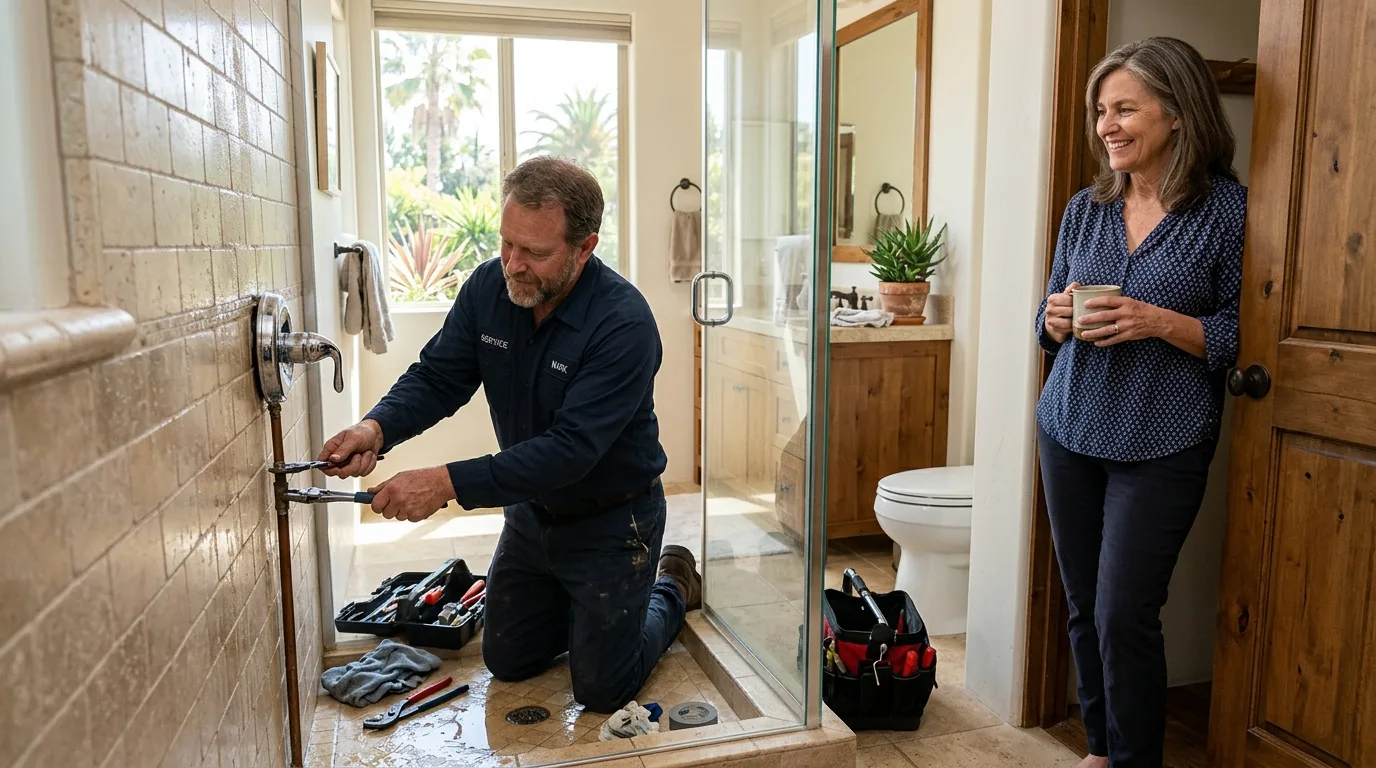
Pipes banging when a valve closes
Water hammer from pressure that is too high or a regulator that has failed. Elevation and system zoning put this area at the top of the range.
Neighbourhood · 92869
Newer construction on higher ground, with a large share of condominium and townhome stock. Two things drive most calls here: incoming pressure at the top of the domestic range, and stacks shared between units.
In a condo or townhome? Say so; it changes who needs to authorise the work and where the fault may actually be.
Answered 24/7
Every hour, every day, including holidays.
Same-day & emergency
Urgent calls get moved to the front of the queue.
Upfront pricing
A number you approve before work begins.
No hidden fees
The price you agreed to is the price you pay.
Workmanship terms upfront
Ask the plumber what their own workmanship terms are before work starts.
What we get called for
Newer housing means fewer corrosion problems and more pressure problems, and the high proportion of attached homes means coordination is often part of the job.
Water hammer from pressure that is too high or a regulator that has failed. Elevation and system zoning put this area at the top of the range.
Cartridges, fill valves, supply hoses and relief valves. High pressure destroys seals faster than anything else.
With a shared stack, waste finds the lowest fixture, which is frequently not the unit that caused the blockage.
Often excess pressure with no thermal expansion tank on a closed system. Never cap that line.
Establishing factually where a leak originates is what the conversation with the HOA needs.
Pressure
Elevation and the way water systems are zoned mean incoming pressure varies considerably across the city, and the hillside areas sit at the high end of what a domestic system should carry. A pressure-reducing valve brings that down to something a house can live with, and it is a wear part, not permanent equipment.
When one fails, it usually fails in one of two directions. High: banging pipes, taps that blast, cartridges and fill valves failing in rotation, a water heater relief valve that drips. Or closed: pressure falling away everywhere at once, which gets mistaken for a corroded supply line.
A screw-on gauge at a hose bib costs very little and answers this in minutes. Check late at night too, when street pressure is typically highest. If the number is high, you have found the explanation for a lot of small annoyances.
Once a regulator is fitted, the system is closed and heated water has nowhere to expand back to. That is what an expansion tank is for. Fitting a regulator without addressing expansion is how you end up with a dripping relief valve and a water heater that ages early.
One number, any hour
Stop replacing parts and get the pressure measured. It takes minutes and usually explains everything.
Attached homes
In a condo or townhome, the drainage stack usually serves several units, and a blockage downstream shows up in whichever fixture sits lowest. That is why a backup in your bathroom may have nothing to do with anything you put down a drain.
Practically, that means two things. First, establishing factually where the fault is, usually with a camera, is what the conversation with the HOA or property manager actually needs. Second, work on shared elements typically needs authorisation from the association rather than from you.
A plumber who works in attached housing treats that coordination as part of the job. Tell us on the first call that it is a condo or townhome and the right pro gets sent.
Houses here are young enough to avoid the galvanized-corrosion story, but they still sit on slab-on-grade concrete with supply lines under the floor. A warm patch underfoot means the same thing it means anywhere else on a slab, and it should be located before anything is cut.
Most asked for here
The cheapest preventative job you own.
Water Pressure RegulatorBatch the small jobs into one visit.
Faucet & Fixture InstallationShared stacks and main-line backups.
Drain CleaningEstablishes where a fault actually is.
Sewer Camera InspectionLocated first, then repair or reroute.
Slab Leak RepairMulti-unit buildings and HOA work.
Commercial PlumbingHOA or property manager involved? Mention it up front so access and authorisation are sorted before the visit.
Straight answers
Water hammer, which usually means incoming pressure is too high or a pressure regulator has failed. This area sits at the high end of the domestic range.
A gauge on a hose bib answers it in minutes, and fixing it prevents a much wider pattern of failures.
High pressure destroys seals and diaphragms, and hard water adds scale. Between them they account for most repeat fixture failures here.
Measure the pressure before buying another part.
Yes. They can fail closed or clog with scale, which starves the whole house and looks exactly like a corroded service line.
That is why a reading should come before anyone quotes pipe replacement.
With a shared stack that is common; waste finds the lowest fixture, which is often not the unit responsible.
A camera establishes where the fault actually is, which is usually what the HOA conversation needs.
Work on shared elements such as a common stack normally needs authorisation from the HOA or property manager rather than from an individual owner.
Tell us it is attached housing on the first call and the right pro is sent, with coordination handled as part of the job.
Usually excess pressure or a closed system with no thermal expansion tank. Sometimes a failed valve.
Never cap or plug that line; it is a safety device. Get the cause identified instead.
Yes. Age reduces corrosion problems but does not remove supply lines from under the concrete.
A warm patch underfoot and a meter that moves with everything off point the same way here as anywhere else on a slab.
Yes, 24 hours a day, every day of the year, holidays included. The hillside streets take a little longer to reach than the flatland tracts, and we will give you a realistic window.
An independent local plumbing professional. Orange CA Plumbing Line is a referral service, not a plumbing contractor; we connect you with a pro who covers your area and does that kind of work routinely.
They diagnose, quote, perform the work and stand behind their own workmanship. Nothing is billed through us.
Tell us the street and the symptom. That is usually enough to name the job.
Nearby, and related
One number, any hour
We will connect you with a local plumbing pro who checks pressure first and knows how attached housing works.