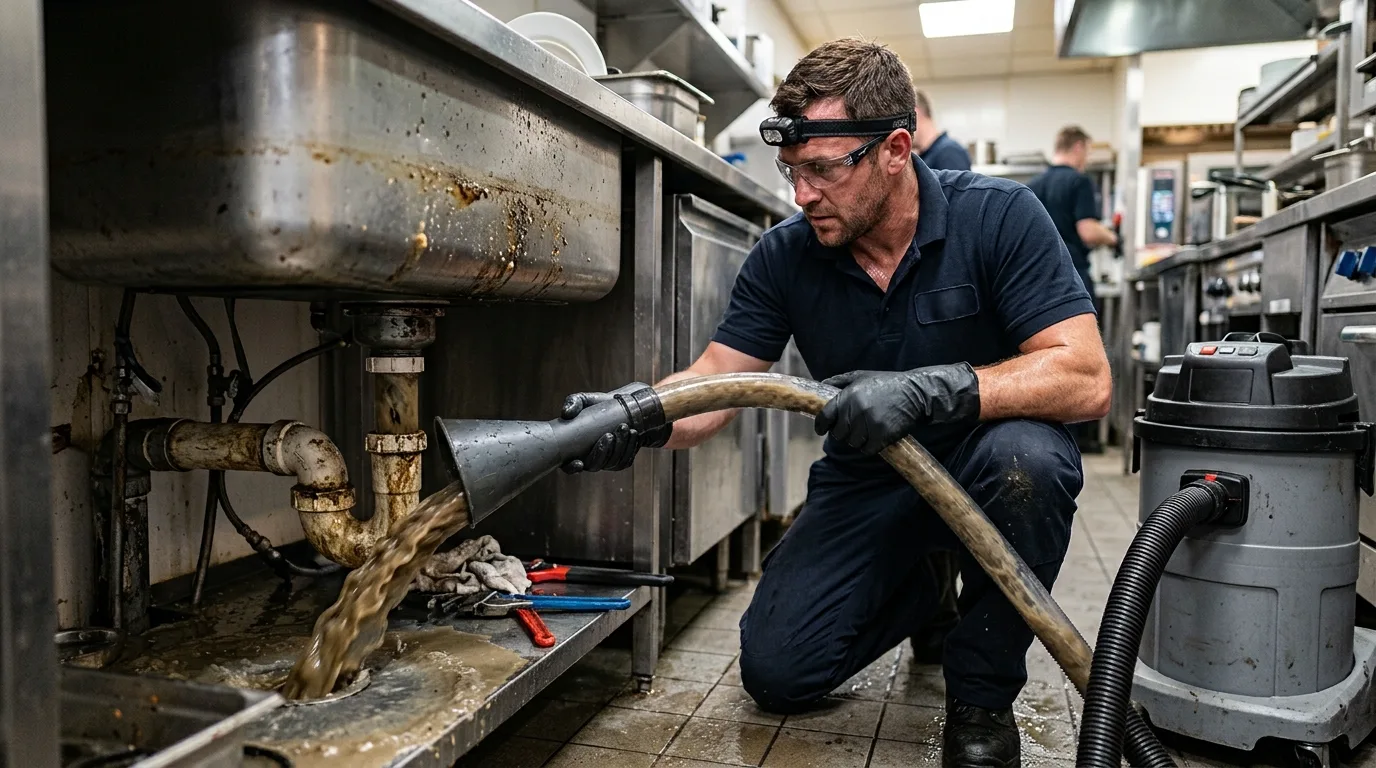
Commercial plumbing in Orange, CA. Planned around your trading hours
Restaurant grease lines and interceptors, shared-wall stacks in condos and apartments, commercial water heating, tenant improvement rough-in, and 24/7 response when a failure closes the doors.
Tell us your trading hours on the first call. Most commercial work is better done at night.
What to expect
Answered 24/7
Every hour, every day, including holidays.
Same-day & emergency
Urgent calls get moved to the front of the queue.
Upfront pricing
A number you approve before work begins.
No hidden fees
The price you agreed to is the price you pay.
Workmanship terms upfront
Ask the plumber what their own workmanship terms are before work starts.
Who this is for
Storefronts, kitchens and buildings with tenants
Commercial plumbing is not residential plumbing at a larger scale. The equipment differs, the requirements differ, and the cost of downtime changes every decision about when and how work gets done.
Restaurants and food service. Grease-heavy kitchen lines, grease interceptors, three-compartment sinks, dishwasher and ice machine connections, floor drains and floor sinks, mop sinks, and the backflow requirements that come with commercial equipment. Around the Plaza and along the older commercial corridors, all of that frequently sits on original drainage in a building that is a century old.
Retail and office. Restroom fixtures under heavy public use, flush valves, hands-free fittings, water heaters sized for a business rather than a household, and the drainage in tenant improvements.
Multi-unit residential. Apartment buildings, condos and townhomes, where a shared-wall stack means a problem in one unit is rarely only that unit’s problem. Santiago Hills has a large share of condominium and townhome stock, and Chapman-adjacent streets hold a substantial rental segment.
Property managers and landlords. Turnover work, recurring maintenance, and the specific need for a plumber who will document what they found and coordinate access with tenants.
Churches, schools and community buildings. Older, heavily used, and typically needing work outside occupied hours.
Business down because of a plumbing failure? Say so on the phone; that changes the priority immediately.
What is different
Why a commercial job is not a bigger house call
Downtime is the real cost
A blocked kitchen line on a Friday evening does not cost the price of the clearance; it costs the service. That is why so much commercial work is scheduled at night or before opening, and why a maintenance programme is usually cheaper than reacting.
Grease is a system, not a clog
Commercial kitchens produce grease at a volume no household matches. Interceptors need servicing, lines need periodic jetting, and the two together are what keep a kitchen running. Cabling a grease line is a temporary measure; scheduled jetting is the actual answer.
Requirements are stricter
Backflow prevention on equipment connections, floor sinks and indirect waste for food service, grease interceptor sizing, and inspection regimes that do not apply to houses. A plumber who works commercially knows what an inspector will look for.
Older commercial buildings are their own category
A retail unit in a building from the 1910s or 1920s may have original cast-iron drainage, undersized supply, and decades of tenant improvements layered on top of each other. Work there starts with finding out what is actually in the walls, and if the building is in the Old Towne historic district, exterior work carries additional review under the city’s Historic Preservation Design Standards.
Coordination is half the job
Tenants, HOA boards, property managers, health inspections and business hours all shape when work can happen. Being straightforward about scheduling is as valuable as the plumbing itself.
Scheduled beats emergency, every time
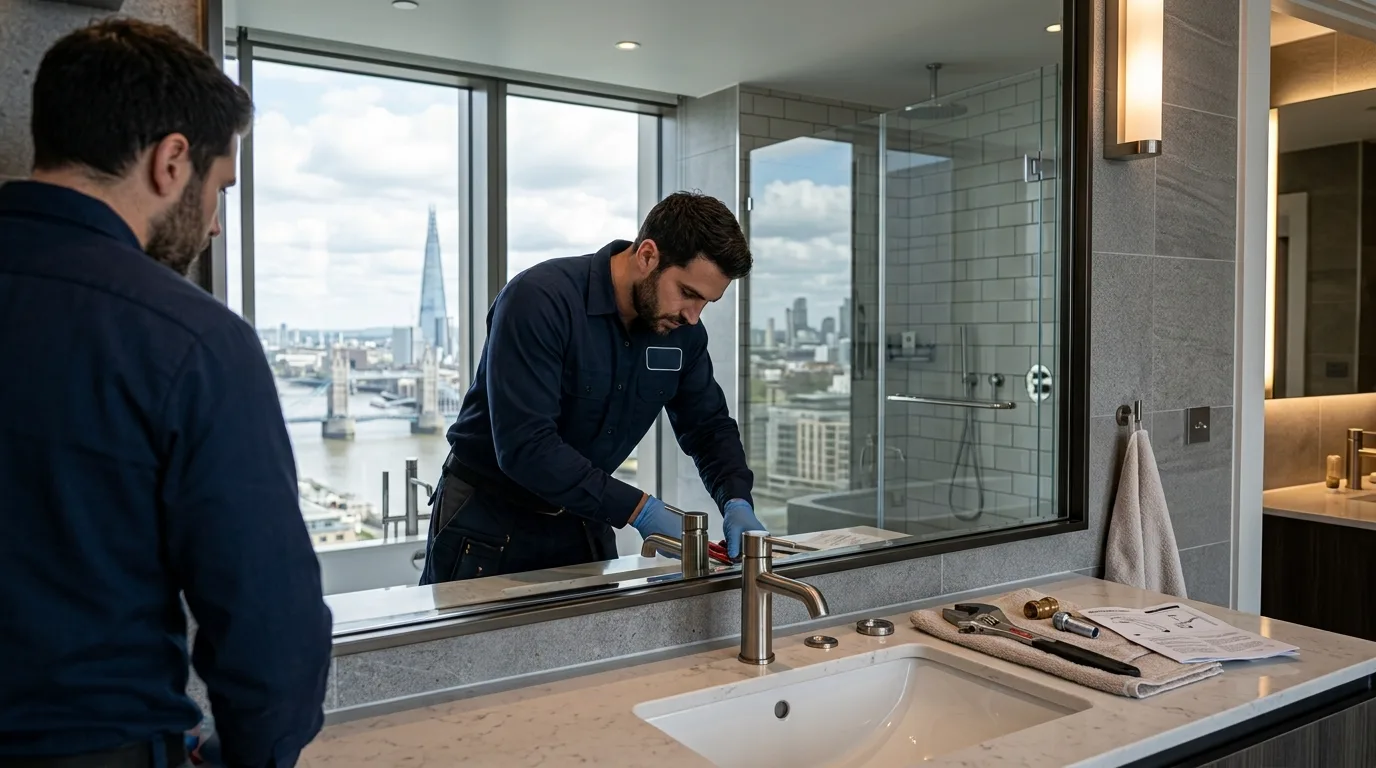
For any food-service operation, a planned jetting and interceptor programme costs a fraction of what emergency call-outs and lost service cost across a year. The same logic applies to a multi-unit building with an ageing stack: a camera survey and a plan beats a 2am backup in a tenant’s bathroom.
Downtime is the expensive part
Get it scheduled instead of waiting for it to fail on a Friday.
Maintenance programmes, night work and camera surveys, all arranged on one call.
Scope
What gets covered
Drains and sewers. Jetting, cabling, camera surveys, main line and lateral repair, trenchless options where excavation would close a business.
Grease management. Interceptor servicing and repair, kitchen line jetting on a schedule, and advice on what is realistically achievable with the drainage a building already has.
Fixtures and equipment. Commercial toilets and flush valves, urinals, hands-free fittings, three-compartment and prep sinks, mop sinks, floor drains and floor sinks.
Water heating. Commercial water heaters and tankless banks, sized for the actual demand of a business rather than a household, including recirculation.
Supply and gas. Repiping, leak repair, pressure regulation, backflow device work, and permitted gas line installation for kitchen equipment.
Tenant improvements. The plumbing side of a fit-out: rough-in, relocations, and coordinating with the other trades on site.
Emergency response. Twenty-four hours a day, because a commercial failure does not wait for business hours and neither should the response.
What shapes a commercial quote
- Scheduled or emergency
- After-hours or overnight work
- Building age and existing drainage
- Access and occupancy
- Permits and inspections
- Grease interceptor involvement
- Backflow requirements
- One-off or maintenance contract
- Coordination with tenants or an HOA
- Historic district considerations
For anything recurring, ask about a maintenance agreement. Predictable scheduled visits at quiet hours cost less than the same work done urgently, and they mostly prevent the urgent version happening at all.
Tell us your trading hours on the first call. It shapes everything about how the work is planned.
Kitchens specifically
Interceptors, intervals and inspection day
Most kitchen emergencies are an interceptor problem that was allowed to become a line problem. The working rule operators are held to is the quarter rule: pump when accumulated fats, oils and grease plus solids reach a quarter of the vessel's depth. For a small under-sink unit in a busy kitchen that can mean monthly attention; for an in-ground interceptor sized for the site, quarterly is the common interval, with heavy fryer operations landing somewhere in between. The interval is set by how fast your kitchen loads the vessel, not by the calendar.
Keep the manifests. A pumping record with dates, volumes and hauler details is the first thing asked for when anything is questioned, and it is the cheapest part of the whole arrangement to get right.
What a failed inspection actually requires
A health inspection failure tied to plumbing is rarely about the interceptor alone. The recurring findings are a hand sink that is blocked, unstocked or not reachable without moving something; missing or dry air gaps on dish machines and prep sinks; a floor sink backing up under a three-compartment sink; and sewage or grease surfacing anywhere in a food area, which is the finding that closes a kitchen the same day.
Correction is usually immediate rather than scheduled: clear the line, restore the air gap, prove the fixture drains, and be ready to show the work at reinspection. That is why kitchen calls get scheduled at night and why the camera survey matters; you want the recurring cause on record before an inspector finds the symptom.
Straight answers
Commercial questions, answered by someone who schedules around you
Do you work outside business hours?
Yes, and for most commercial jobs that is the sensible approach. Overnight and pre-opening work avoids the downtime that costs far more than the plumbing.
Tell us your trading hours on the first call and the work gets planned around them.
How often should a restaurant kitchen line be jetted?
On a schedule rather than on failure. The right interval depends on volume, menu and the age and condition of the drainage, which is what a camera survey establishes.
A planned programme costs a fraction of emergency call-outs plus lost service across a year.
Do you service grease interceptors?
Yes, servicing, repair and advice on what a building’s existing drainage can realistically handle.
Interceptor work and line jetting go together; doing one without the other rarely solves a recurring problem.
Can you handle plumbing in a multi-unit building?
Yes, including shared-wall stacks where a problem in one unit affects others. That work needs coordination with tenants, an HOA or a property manager, which is part of the job rather than an afterthought.
Camera surveys are particularly worthwhile on an ageing stack.
We are in a very old building. Is that a problem?
It is a reason to survey before quoting. A commercial unit from the 1910s or 1920s may have original cast-iron drainage, undersized supply and layers of past tenant improvements.
If the building is in the Old Towne historic district, exterior work also carries additional review under the city’s Historic Preservation Design Standards.
Do you do tenant improvement work?
The plumbing side, yes: rough-in, relocations, fixture and equipment connections, and coordinating with the other trades on site.
Permits and inspections are part of that, and they usually set the schedule.
Can you avoid digging up our parking lot for a sewer repair?
Often. Trenchless lining and pipe bursting exist precisely to avoid closing a business, and a camera survey determines whether your line is a candidate.
Where excavation is unavoidable, the work can usually be staged to keep part of the site operating.
Do you offer maintenance agreements?
Yes, and for food service and multi-unit buildings they are usually the economical route. Scheduled visits at quiet hours, at a predictable cost.
Ask when you call and it can be quoted alongside whatever brought you here.
Who performs the work?
An independent local plumbing professional. Orange CA Plumbing Line is a referral service, not a plumbing contractor; we connect you with a pro who works commercially and understands the requirements.
They quote, perform the work and stand behind their own workmanship. Nothing is billed through us.
Describe the site, the trading hours and what is failing. We will match you to the right pro.
Often part of the same job
Related services and neighbourhoods
One number, any hour
Keep the doors open.
We will connect you with a local plumbing pro who works commercially and schedules around your business.