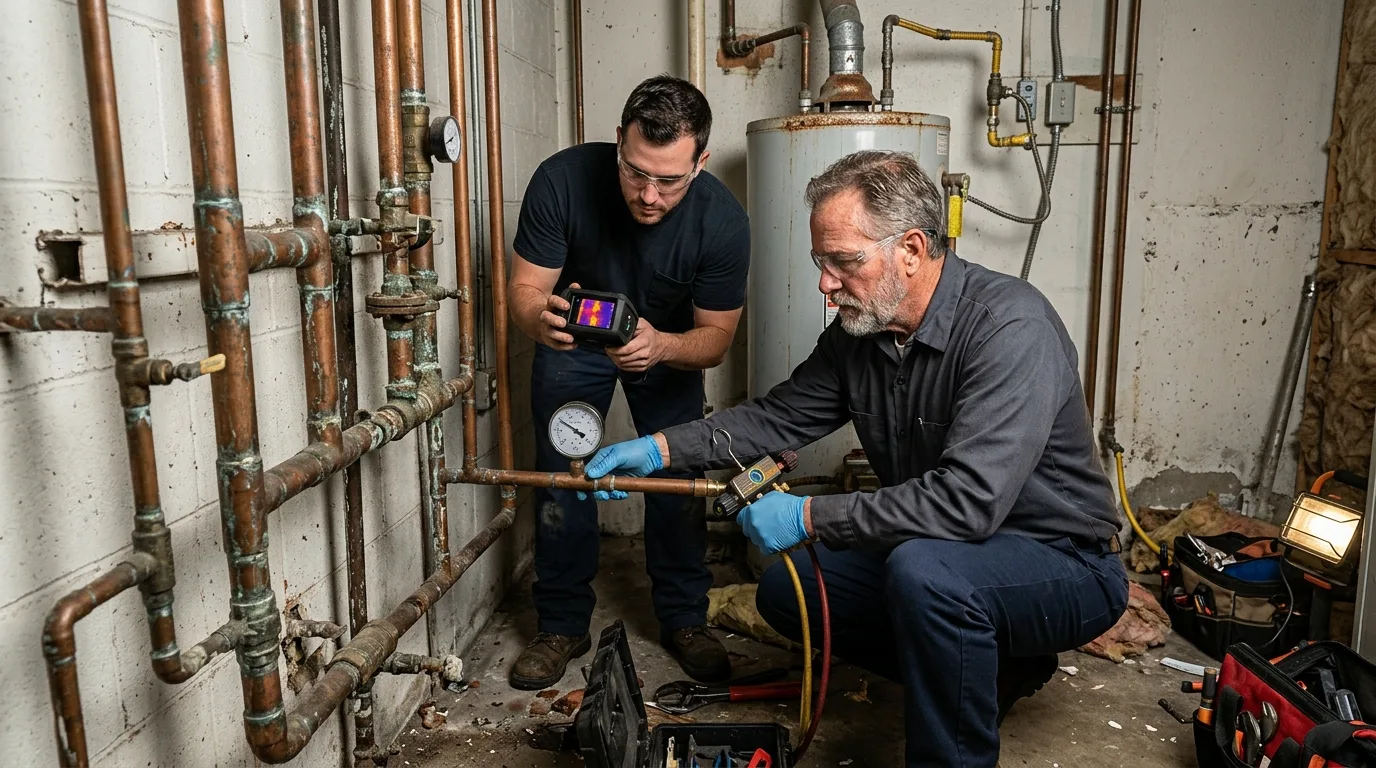
A warm patch underfoot
The classic Eichler symptom. Either a hydronic heating loop has failed inside the concrete, or a domestic hot-water supply line under the same slab has. Same feeling, unrelated repairs.
Eichler tract · Orange, CA
An Eichler tract in the City of Orange with hydronic heating pipe cast into the concrete and domestic supply lines under the same slab. One symptom, two completely different repairs.
Say "Eichler" and "radiant slab" on the phone. It changes who gets sent.

Answered 24/7
Every hour, every day, including holidays.
Same-day & emergency
Urgent calls get moved to the front of the queue.
Upfront pricing
A number you approve before work begins.
No hidden fees
The price you agreed to is the price you pay.
Workmanship terms upfront
Ask the plumber what their own workmanship terms are before work starts.
Why this page exists
Almost everyone who lands here has felt a warm patch on the floor. In most of the country that means one thing. In an Eichler it means two, and the difference between them is the difference between an afternoon and a project.
The classic Eichler symptom. Either a hydronic heating loop has failed inside the concrete, or a domestic hot-water supply line under the same slab has. Same feeling, unrelated repairs.
A heater or boiler cycling far longer than it used to, a gas bill climbing season over season, rooms that never warm. Loops losing water, or scale and sediment choking the circuit.
This one you can check yourself, and it settles the question faster than anything else. Movement means a pressurised domestic leak, not a heating loop.
Moisture wicking up at a baseboard, sometimes with flooring lifting. Under-slab water that has been running long enough to reach the framing.
The one thing to refuse. Nobody should be cutting concrete before establishing which of the two systems is losing water.
The distinction that matters
A domestic supply line can be abandoned and rerouted overhead in an afternoon, and the house carries on exactly as before. The old line stays in the slab, dead and harmless.
A radiant loop is the heating system. Abandoning it means deciding how the house will be heated instead, and in a single-storey house with a flat roof, no attic and floor-to-ceiling glass, that is a real project with real consequences for how the place feels to live in.
Telling them apart does not require breaking anything. Thermal imaging reads the whole radiant grid off the floor surface and shows where the pattern breaks or intensifies. Pressure isolation separates the domestic system from the heating circuit and watches which one loses pressure. Both are same-visit tests.
Get that answer before you get a price. A quote that does not name the failing system is a quote for exploratory demolition.
Turn off every fixture and every irrigation zone, note the leak indicator on the water meter, wait fifteen minutes and look again. Movement means a pressurised domestic leak. No movement, with a warm floor and a hard-working heater, points at the radiant circuit. Fifteen minutes, and it changes the conversation.
If it is the radiant grid
A single failure point can sometimes be located and repaired by opening the slab at that spot alone. Whether that is worth doing depends entirely on the condition of the rest of the grid, one repair on a sound system is money well spent, one repair on a grid that is failing everywhere is the first of several.
Abandoning the loops is the other honest path, and it turns a plumbing repair into a heating decision: overhead hydronic, ducted forced air, or ductless heads. Each is used in these houses and each trades cost against how much of the ceiling plane and the glass you are willing to give up.
What matters is that the choice is put to you as a choice. Anyone who arrives with the answer already decided has not looked at your grid.
The two other Eichler tracts in the city get their own pages, because the questions there tend to be different ones, routing new pipe through a house with no attic, and everything on the drainage side.
Fairhills covers repiping and routing in a post-and-beam house. Fairmeadow covers drains, the atrium and the lateral. Same construction, different problems.
One number, any hour
We will connect you with a local pro who has opened one of these slabs before and will tell you which system is failing.
Most asked for here
Supply line or radiant loop, two different jobs.
Slab Leak RepairThermal imaging reads the whole radiant grid.
Leak DetectionRetiring under-slab supply for good.
Whole-Home RepipingCompact utility space, no attic to vent through.
Water Heater InstallationAnswered 24/7, holidays included.
Emergency PlumbingPressure that shortens the life of everything.
Water Pressure RegulatorIf the floor is warm and the heating is struggling, say both. They are usually the same story.
Straight answers
It is at least as likely to be a failing hydronic radiant heating loop cast into the concrete as a domestic hot-water supply line. Both produce a warm patch.
They are not remotely the same repair, which is why the diagnosis comes first. Say “Eichler” and “radiant” when you call so the right person is sent.
Thermal imaging is the quick answer, a radiant grid reads as a pattern across the whole floor, and a failure interrupts or intensifies it. A supply leak is a localised hot spot with no pattern.
Pressure isolation confirms it: if the domestic system holds pressure with the heating circuit isolated, the loss is in the heating loop.
Sometimes. A single failure point can be located and the slab opened at that spot. Whether it is worth doing depends on the age and condition of the rest of the grid.
The honest options are repair, abandon the loops and reroute heating overhead, or convert to another system entirely. Each changes cost, disruption and how the house feels.
That is the real question, and it is a project rather than a same-week job. Overhead hydronic, ducted forced air and ductless heads are all used in these houses.
A flat roof, floor-to-ceiling glass and no attic constrain where anything can run, so it wants planning. Anyone quoting it over the phone is guessing.
A classic sign of a radiant system losing efficiency, leaking loops, or scale and sediment in the circuit making the heater run far longer than it should.
Worth diagnosing rather than living with, because it is costing you every month.
Usually, yes, and that is the good outcome. A failed under-slab supply line is abandoned in place and a new run is taken overhead or through walls.
The heating grid is left exactly as it was. This is why establishing which system failed is worth the diagnostic visit.
Yes. Shut every fixture and irrigation zone, read the leak indicator on the meter, wait fifteen minutes, read it again.
Movement points at a pressurised domestic leak. No movement, plus a warm floor and a hard-working heater, points at the radiant circuit.
Parts of the city's midcentury tracts sit inside locally designated areas, and designation concerns exterior character rather than interior plumbing. Under-slab and interior work proceeds normally.
Anything visible is worth checking with the City of Orange first. That means a roof or wall penetration, or exterior equipment on a street-facing elevation. Your plumber can tell you what is usually expected; we do not obtain approvals for you.
An independent local plumbing professional. Orange CA Plumbing Line is a referral service, not a plumbing contractor.
They diagnose, quote, perform the work and set out their own workmanship terms with you. Nothing is billed through us.
Tell us what the floor is doing and what the heating is doing. That names the job.
Nearby, and related
One number, any hour
We will connect you with a local plumbing pro who knows the difference between a radiant loop and a supply line.