Leak detection in Orange, CA. Located before anything gets opened
Acoustic listening, thermal imaging, pressure isolation and tracer gas. Under slabs, inside plaster walls, out in an irrigation field on an acre lot. The point is to make one opening instead of six.
Do the meter test first, fifteen minutes with everything off tells us where to start looking.
What to expect
Answered 24/7
Every hour, every day, including holidays.
Same-day & emergency
Urgent calls get moved to the front of the queue.
Upfront pricing
A number you approve before work begins.
No hidden fees
The price you agreed to is the price you pay.
Workmanship terms upfront
Ask the plumber what their own workmanship terms are before work starts.
Before the visit
Three things you can establish yourself in half an hour
None of this replaces equipment, but it narrows the search enormously and it costs you nothing.
Read the meter with everything off
Close every fixture, stop the dishwasher and washing machine, switch the irrigation controller off. Find the meter at the front of the property and note the leak-indicator dial or the last digit. Wait fifteen minutes and look again. Movement means water is leaving your system.
Close the house valve and read it again
If your property has a shutoff between the meter and the house, close it and repeat. Still moving? The leak is outside the house, the main service line, the irrigation system, a pool line. Stopped? It is inside or under the house.
Rule out the toilets
A leaking flapper is the most common phantom water user there is, and it is silent. Put a few drops of food colouring in each tank, wait twenty minutes without flushing, then look in the bowl. Colour in the bowl means that toilet is running water straight through, all day.
Bring those three answers to the phone call and the visit is shorter, more targeted and cheaper.
The equipment, and what each part is for
How a hidden leak is actually found
Detection is a process of elimination, not a single gadget. A good technician narrows the field before reaching for anything expensive, which is why the visit often starts with valves and a pressure gauge rather than a camera.
Pressure isolation
The house is isolated at the main and a gauge is fitted. A falling gauge proves loss and roughly indicates its scale. Splitting hot from cold then tells the technician which system is losing water, and under a slab, it is usually the hot side.
Acoustic listening
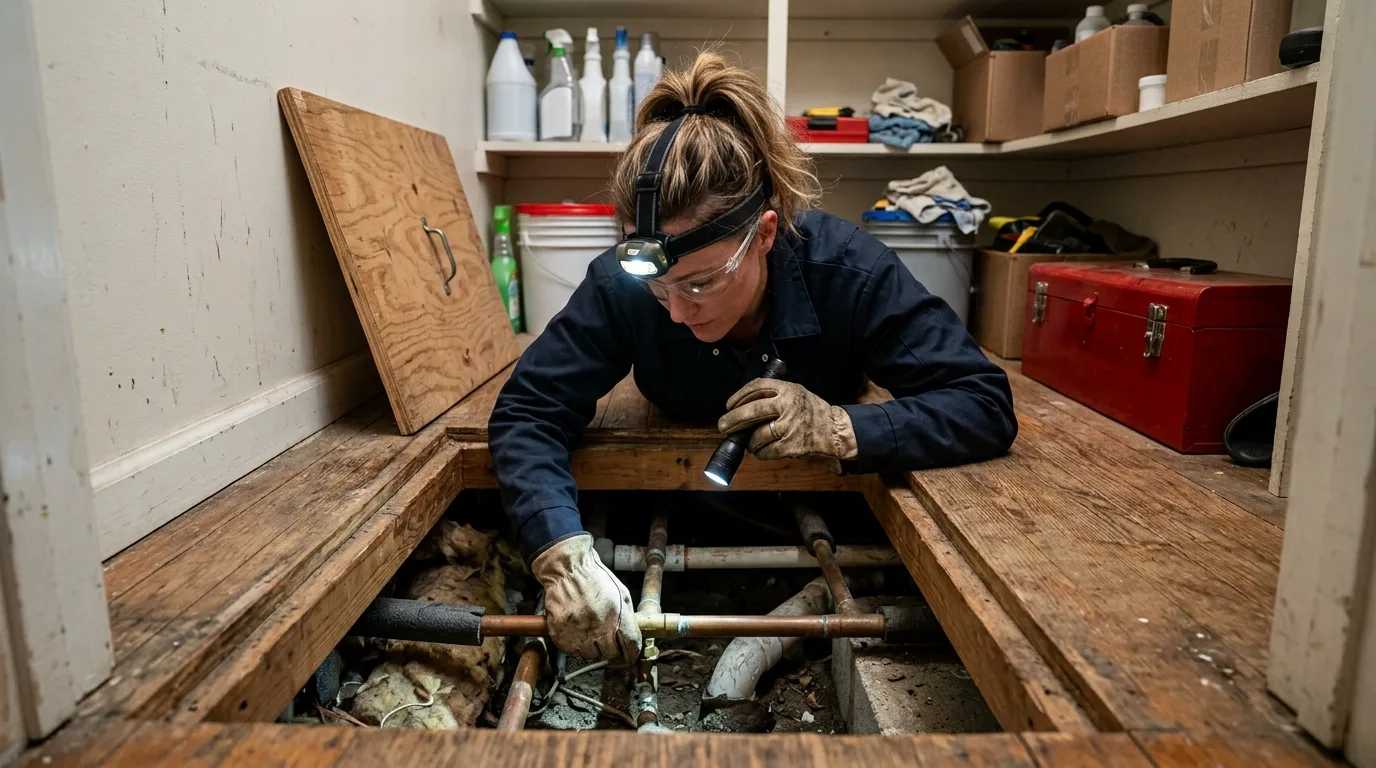
Pressurised water escaping through concrete, soil or plaster makes a specific noise. Ground microphones and contact probes pick it up and the loudest point is usually within a foot or two of the break. It needs a quiet house: no air conditioning, no footsteps, nothing running.
Thermal imaging
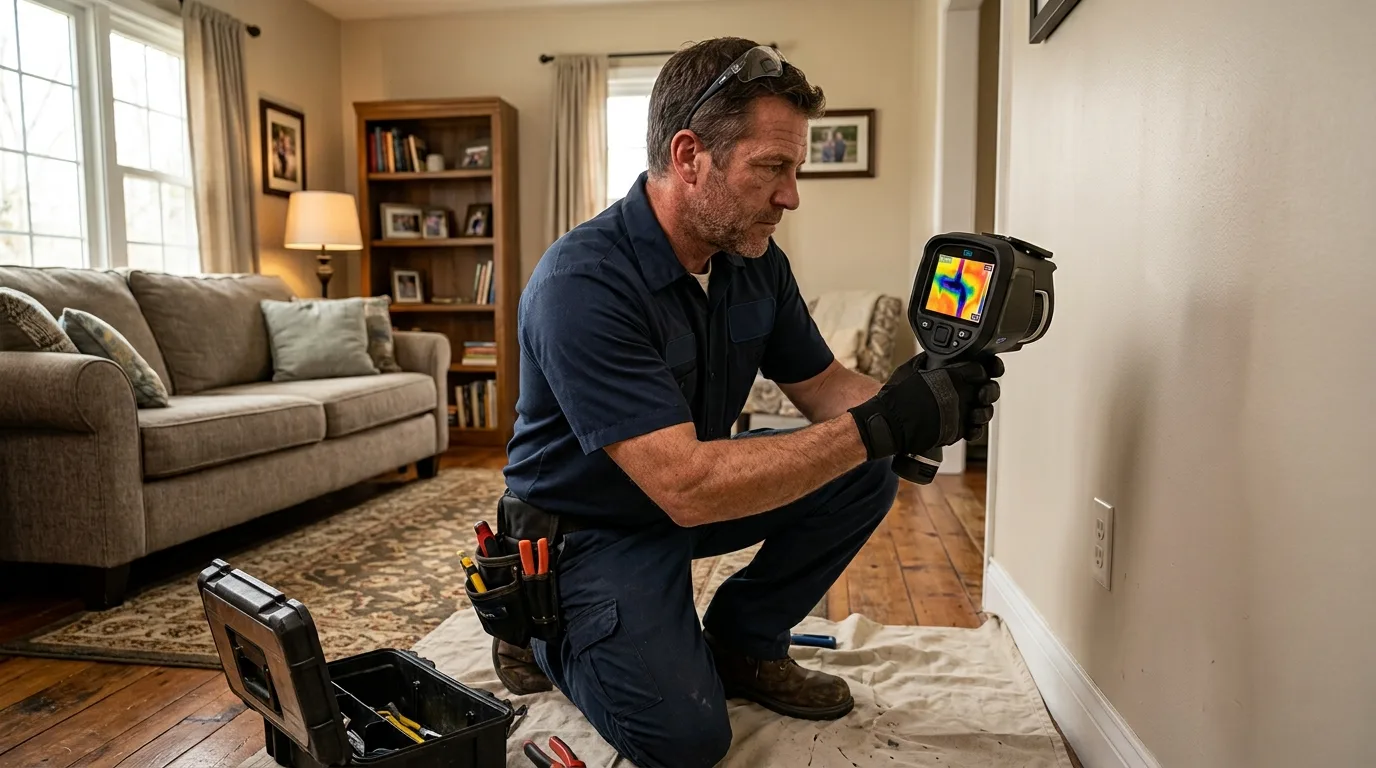
A hot-water leak spreads heat through a slab or a wall cavity in a pattern a thermal camera can read straight off the surface. It is also how a hydronic radiant heating grid is traced in an Eichler, because the whole loop lights up and you can see where the pattern breaks.
Tracer gas
For a leak that will not give itself away, the line is drained and charged with a safe inert tracer gas that escapes at the failure point and rises to the surface, where a probe detects it. This is the method for small losses and awkward locations.
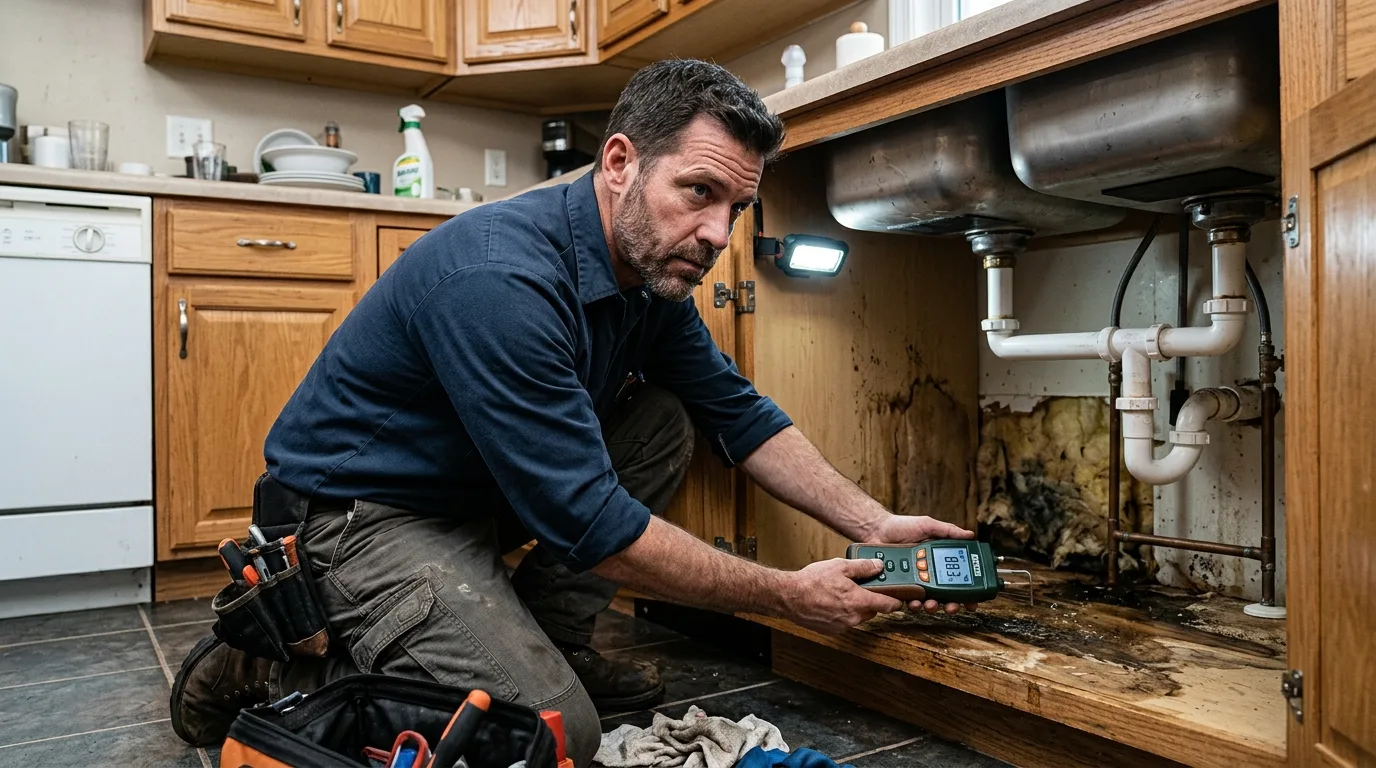
Moisture meters and drain cameras
Pin and pinless meters map how far moisture has travelled through drywall, subfloor and framing, which decides how much has to come out. And when the meter is not moving at all, the water is not pressurised; that points at a drain or sewer line, and the tool for that is a camera.
A detection visit should end with a mark on the floor or the wall, a description of the line involved, and a repair conversation. Not a shrug and a suggestion to start opening things up.
Why paying for detection saves money
The alternative to detection is exploratory demolition: cut drywall, lift flooring, break concrete until the leak appears. A detection pass is a fixed, known cost, quoted and approved before it starts. Opening a slab in the wrong place is not recoverable; you pay for the mistake and then pay again for the repair.
Find it, then fix it
Nobody should be cutting into your house to look for something.
Detection is priced and approved on its own, before any repair is discussed. Ask how it works.
Where they hide in Orange houses
The usual suspects, by era
1890s to 1920s, Old Towne and the Plaza District. Original galvanized steel supply pipe corroding from the inside, with pinholes appearing at threaded joints and inside plaster-and-lath walls. Add a century of remodels: pipe abandoned in place, dissimilar metals joined without a proper transition, and lines running through spaces nobody would route them through today. Detection here is as much detective work as instrumentation.
The Eichler tracts. Fairhaven, Fairhills and Fairmeadow have radiant heating pipe in the slab as well as domestic supply lines, so the first question is which system is losing water. Thermal imaging answers it quickly. Sending someone who does not know the difference means a diagnosis you cannot trust.
Postwar and 1970s to 90s slab-on-grade tracts. El Modena, Olive, McPherson, Marlboro and the newer subdivisions: under-slab copper failing at bends and penetrations, and hot lines failing well before cold ones. Acoustic plus thermal is the standard combination.
Hillside and large-lot properties. Cerro Villa Heights, Santiago Hills and Orange Park Acres bring long private service lines, booster pumps and extensive irrigation on acreage. On these properties an unexplained meter reading is at least as likely to be an irrigation valve or a broken lateral out in the field as anything under the house, and finding that is a different search entirely.
Anywhere with a pool. A pool losing water beyond normal evaporation, or a pool line under a deck, will not show on the house meter if it is fed separately. Mention the pool. It gets ruled in or out early.
Money
What a detection visit depends on
- How much you have already narrowed it down
- Inside the house or out on the property
- Under slab, in wall, or buried
- Methods required to confirm it
- Size of the property
- Access to shutoffs and manifolds
- Pressurised line or drain line
- Whether irrigation or pool is involved
Two fair questions to ask before the visit: is the detection fee credited toward the repair if you go ahead, and what happens if the leak cannot be pinned down on the first pass. Reasonable outfits have a clear answer to both. Ask on the phone rather than at the door.
Come with your meter reading and your toilet test. It genuinely changes what the visit costs.
Straight answers
Leak detection questions, answered without the sales pitch
How accurate is leak detection?
On a pressurised line, a competent acoustic and thermal pass usually places the leak within a foot or two, close enough to make one clean opening instead of several exploratory ones.
Accuracy drops with depth, background noise and very small losses, which is when tracer gas earns its keep.
Can you find a leak without breaking anything?
Locating it, yes. That is the whole point: acoustic gear, thermal imaging, pressure isolation and tracer gas all work from the surface.
Repairing it eventually requires access somewhere, but detection means the access is one considered opening rather than a search.
My water bill jumped but I cannot see anything wet. Is that possible?
Very. A running toilet flapper, an under-slab supply line, a buried irrigation break or a failed pool line can all consume large volumes with nothing visible indoors.
Start with the meter test and the food-colouring test on every toilet. Those two rule out or confirm the cheapest explanations first.
Do you charge for detection separately from the repair?
Detection is its own step, priced and approved before it starts, and the repair is quoted afterwards once the plumber knows what they are dealing with.
Whether the detection fee is credited toward the repair varies by pro. It is a fair question to ask when you call, and you should get a straight answer.
Can you tell whether it is a supply leak or a drain leak?
Yes, and it is one of the first things established. A pressurised supply leak shows on the meter with everything off; a broken drain or sewer line does not, because that water is not under pressure.
Supply leaks are traced acoustically and thermally. Drain problems are inspected with a camera, and that is a different service.
I own an Eichler. Can you tell a radiant loop from a plumbing leak?
That is exactly what thermal imaging is good at. A hydronic radiant grid cast into the slab shows as a pattern across the whole floor, and a failure interrupts or intensifies that pattern.
Fairhaven, Fairhills and Fairmeadow all have radiant slabs decades past their design life, so it is worth ruling in or out early. Mention the tract when you call.
Is the leak on my side of the meter or the water company’s?
If the meter moves with the house valve closed, the loss is between the meter and that valve, your service line, or irrigation teed off it. If it stops, the leak is inside or under the house.
Anything on the street side of the meter is the utility’s to deal with, and the plumber will tell you when that is what they are seeing.
How long does a detection visit take?
A well-narrowed single-leak search is often an hour or two. A large property with irrigation, a pool and several possible sources takes longer, and so does an older house with unknown pipe routing.
A quiet house makes it faster. Acoustic work is genuinely disrupted by air conditioning, footsteps and traffic.
Should I turn the water off while I wait?
If water is visibly running or you know damage is happening, yes, close the main and open the lowest faucet in the house.
If the leak is slow and hidden, leaving the system pressurised until the technician arrives actually helps, because a pressurised leak is what the equipment listens for. Ask when you call and we will tell you which applies.
Tell us the meter reading, the bill, and anything you can see or hear. That is where the search starts.
Often part of the same job
Related services and neighbourhoods
One number, any hour
Stop guessing where the water is going.
We will connect you with a local plumbing pro who locates leaks for a living, in houses built the way yours was.